

Six months. One loop, repeated every week: learn it, build it, get graded, show it.
This page is the whole MAT method, start to finish: what the six months look like, what a week looks like, how the lab works, how you are graded, what the capstone is, and what happens after you finish. If you read one page before applying, read this one.
Four phases, 26 weeks, one direction: a job
Cohort 1 runs from 15 January to 16 July 2027. Everyone starts together in Foundation, splits into tracks in week 5, comes back together for the capstone in week 19, and spends the last four weeks getting ready for exams and interviews.
-
Weeks 1–4
Foundation
How a plant works, how a loop works, how safety is layered. Four weeks everyone takes, so the tracks never re-teach the basics. Four graded practicals. At the end you confirm your track, and you can switch without losing anything.
-
Weeks 5–18
Your track
Five three-week courses in Industrial Automation, Process Control or Instrumentation, each ending in a graded practical, plus a track project you build and defend. Twenty-five students per track, one lead instructor who knows your work.
-
Weeks 19–22
Capstone
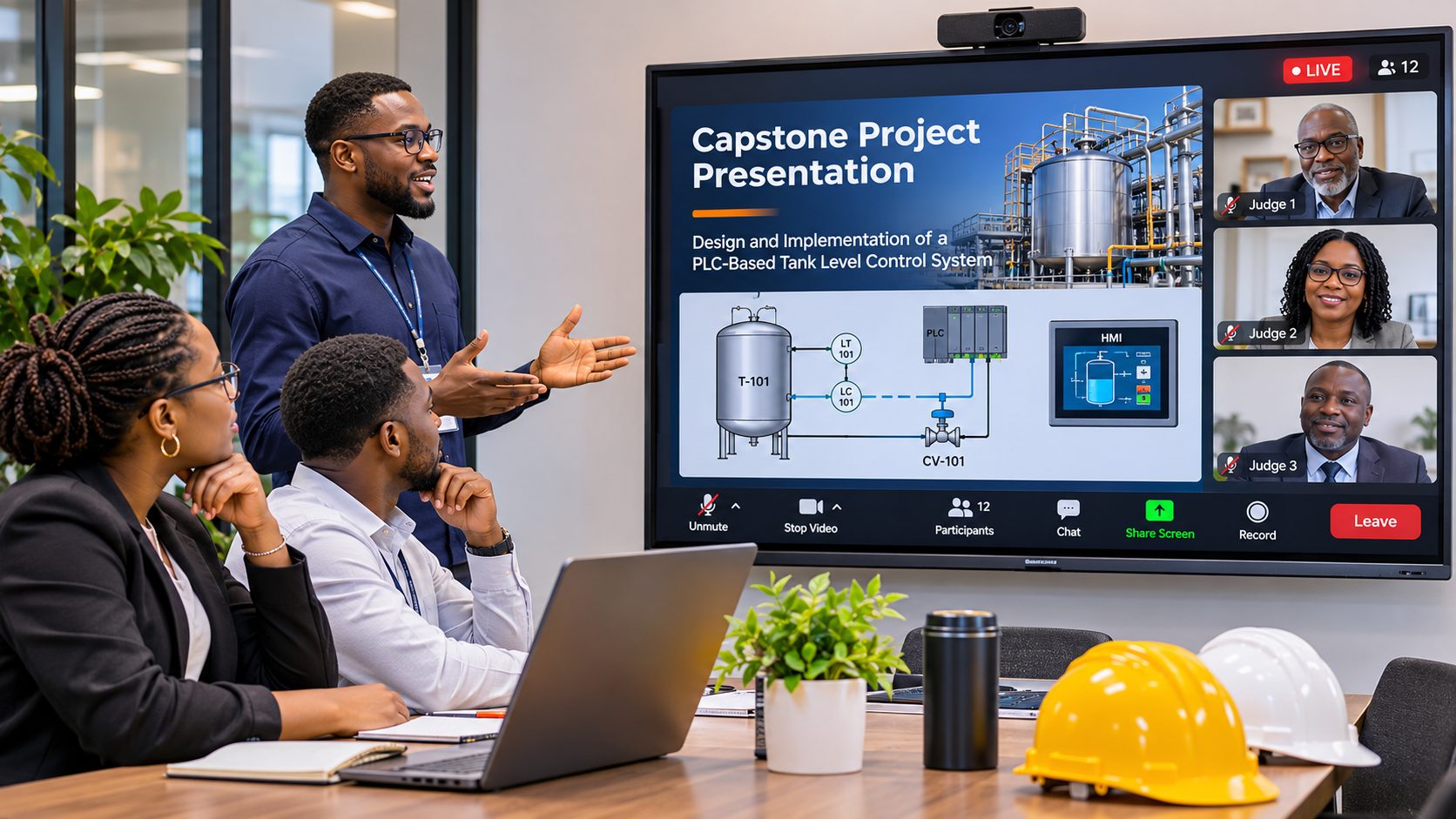
Teams of three to four, one from each track, take a plant from P&ID to a running, protected process. An industry mentor per team. Judged by engineers from operating companies and contractors on a published rubric.
-
Weeks 23–26
Exam prep and career
ISA CCST, ISA CAP or TÜV functional-safety preparation with a guest expert, plus CV, portfolio and interview sessions, and the employer showcase where hiring partners watch the capstone presentations.
26
weeks
18
graded practicals (4 Foundation + 14 track)
52
live classes, all recorded
1
capstone, judged by industry
About six hours, around a job
MAT is built for people who work. Live classes are in the evening, the clinic is Saturday morning, and the lab is open whenever you are. Every class is recorded within the hour, so a late shift never costs you a week.
-
Mon
Watch the 12-minute pre-class video and read the notes
Lab open
-
Tue
19:00–21:00 live class
Concept, worked on real plant examples
Lab open
-
Wed
Quiz and start the practical
Lab open
-
Thu
19:00–21:00 live class
Worked problems, Q&A, troubleshooting
Lab open
-
Fri
Finish the practical, write it up
Lab open
-
Sat
10:00–12:00 practical clinic
Small-group review with your instructor
Practical due 18:00
-
Sun
Off
Lab open
Live classes · 4 hours
Interactive, not a lecture. You will be asked to read a trend or a drawing and say what is happening before the instructor does. Recordings up within the hour; slides and notes the same day.
Lab and practical · 2–3 hours
Your own time, your own pace, any hour. A teaching assistant, usually a MAT graduate now in industry, answers questions on the cohort channel within hours.
Saturday clinic · 2 hours
Groups of eight. You walk the group through your practical, your instructor asks why you chose what you chose, and you see how seven other people solved the same problem.
Every module runs the loop a control engineer would recognise
The setpoint is a job in automation, control or instrumentation. The process variable is what you can prove you have built. Every week the loop closes: a class sets the concept, the practical makes you apply it, the grade tells you the error, and the clinic corrects it before the next module. Fourteen times in a track, and the error gets small.
- Learn: a practising engineer teaches the concept live, with plant examples.
- Build: you apply it yourself in the MAT Lab, on a process that fights back.
- Get graded: against a rubric you saw before you started, by the person who taught it.
- Show it: the write-up and data log go on your public portfolio the same week.
A real plant to practise on, without a plant
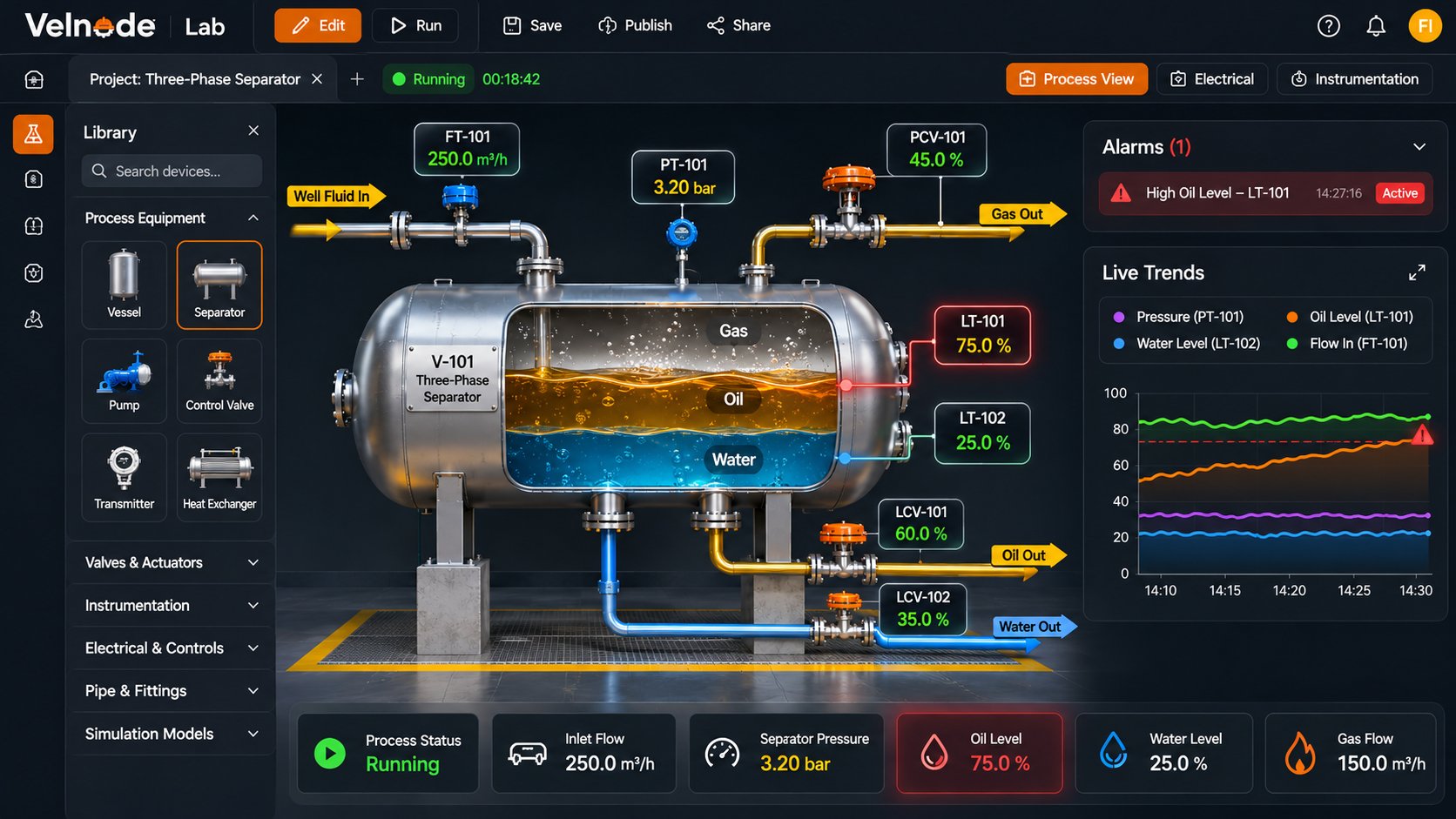
The MAT Lab is where every practical happens. Powered by Velnode, Madesoft's industrial process simulator, it gives you your own live process models: tanks, heat exchangers, fired heaters, distillation columns, separators and packaging lines, each with realistic dynamics, dead time, noise, alarms and trips. You configure, tune, break and fix them in a browser, on a normal laptop, on Nigerian bandwidth, 24 hours a day.
Every run is logged. Your instructor sees exactly what you tried, in what order, and what the process did. That log is attached to your graded practical and to your portfolio, so an employer can see not just your answer but how you got there.
- Models
- 25 across three tracks, 5 more for cohort 2
- Realism
- Dynamics, dead time, noise, stiction, trips
- Runs on
- Chrome, any laptop, low bandwidth
- Alongside
- Vendor PLC, HMI and sizing tools
Tank level loop
Wire it end to end, tune it by hand, add a high-high trip and prove it fires.
Packaging line
PLC logic, HMI screens, alarm handling and a start-up sequence to steady state.
Distillation column
Cascade and feedforward to hold purity through feed upsets, written up like a contractor.
Three-phase separator
Specify, size and calibrate every instrument; produce the loop sheets to ISA 5.1.
Sixty percent of your grade is work a plant would pay for
You see every rubric before you start. Practicals are graded by your lead instructor within a week and reviewed in the Saturday clinic. Quizzes are short and automatic. The track project is a bigger piece of work you build over the last three weeks of the track and defend live. Pass mark is 65 %; if you attend the live classes and submit every practical, almost nobody falls under it.
Miss a class and you watch the recording and still submit the practical. Two missed practicals without make-up means repeating the module in the next cohort. We say this up front because it is the one rule that keeps the cohort honest.
| Weight | Component | How it works |
|---|---|---|
| 40 % | Graded practicals | One per module, in the MAT Lab, graded by your instructor against a published rubric. Data log attached. Published to your portfolio. |
| 20 % | Quizzes and assignments | Short weekly quizzes on the portal plus one assignment per course. Auto-marked, instant feedback. |
| 40 % | Track project | Weeks 16–18: a complete piece of work on your track's plant model, written up and defended in a 15-minute review with your instructor and a guest expert. |
Foundation certificate
Week 4 · pass all four practicals
Track certificate
Week 18 · 65 % overall
MAT Professional Certificate
Week 22 · capstone passed · verifiable online
- Team
- 3–4, one per track
- Mentor
- 1 industry engineer
- Judges
- 3, from operators and EPCs
One plant. P&ID to a running, protected process.
In week 19 your team receives a plant: a P&ID, a process description and a set of operating requirements. The instrumentation student specifies and sizes the instruments. The process-control student designs the control strategy. The automation student builds the PLC logic and HMI. Together you commission it in the MAT Lab, prove the trips, and present it to a panel of working engineers on a published rubric.
It is the closest thing to a first project you can get before your first project, and hiring partners are invited to watch the presentations. Several of our instructors first met their current employers this way.
We don't stop at the certificate
The last four weeks turn what you built into a job search. You choose an exam path, your portfolio is tidied into something an employer can read in five minutes, and you practise the interview that control engineers actually get: a trend on the screen and the question “what is this loop doing?”
ISA CCST, ISA CAP or TÜV FS
Practice questions and two sessions with a guest expert who holds the credential. Exam fees are separate and optional.
Public from week 3
Every graded practical with its data log, your track project and your capstone, on one link you put at the top of your CV.
CV, interviews, job search
Three sessions: a CV that leads with work not degrees, technical mock interviews, and a 90-day job-search plan.
Employer showcase
Hiring partners watch the capstone presentations and receive the graduate portfolio list the same week.
A laptop, a connection, and six hours a week
- Computer
- Any laptop from the last five years, 8 GB RAM, Chrome. No special graphics card.
- Connection
- Enough for a video call. The lab is light on data; recordings can be downloaded on Wi-Fi.
- Background
- An engineering, science or technical diploma or degree, or two years on a plant.
- Time
- Tue and Thu 19:00–21:00, Sat 10:00–12:00 WAT, plus two to three hours in the lab.
- Software
- All provided: the MAT portal, the MAT Lab, and free vendor tools (CODESYS, TIA Portal and Ignition trials) where a course uses them.
- Location
- Anywhere. Classes are West Africa Time and recorded; students outside Nigeria pay in US dollars.
The tools plants actually run
PLC programming
CODESYS for everyone; Siemens TIA Portal and Rockwell Studio 5000 trials for depth.
HMI and SCADA
Ignition Maker and FactoryTalk View trials.
P&IDs and loop sheets
draw.io with the ISA symbol library; ISA 5.1 conventions throughout.
Instrument and valve sizing
Vendor sizing tools from Emerson and Fisher, free online.
Functional safety
LOPA worksheets and a SIL calculator; exSILentia trial in cohort 2.
The MAT Lab
Every practical, every model, every trip, in your browser.
Is it really fully online? No lab days in Lagos?
Yes. Every practical runs in the MAT Lab in your browser. Cohort 1 has no in-person days. Employer site visits may be offered where partners allow, but they are optional.
What if I work shifts and miss live classes?
Every class is recorded within the hour. You watch the recording, do the practical and still get it graded. The Saturday clinic is the one you should try hardest to attend.
How big is a class?
Twenty-five per track. Saturday clinics run in groups of eight.
Who grades my work?
Your lead instructor, the same engineer who taught the module, against a rubric you saw before you started. Quizzes are automatic.
Can I switch tracks?
Yes, at the end of Foundation in week 4, without losing any work. After week 5 a switch means restarting the track in the next cohort.
What if I fail a practical?
You resubmit once within a week. The clinic exists to catch problems before that happens.
Can I take one course instead of a track?
Yes. Every course is sold on its own at the same live schedule with the same graded practical. Finish three in one track and upgrade for the difference.
What is the MAT Lab, technically?
A browser-based industrial process simulator, Velnode, built by Madesoft. It models real equipment with real dynamics and logs every run. Technical institutes and plants use the same platform.
Cohort 1 starts 15 January 2027
75 places across three tracks. Applications close when the cohort fills.