

• PC-03
  • Process Control · course 3 of 5
  • Graded practical

Cascade, Ratio and Feedforward

Three weeks on the strategies that fix what one loop cannot: cascade, ratio and feedforward, designed, tuned and justified.

weeks
3
live classes
6
graded practical
1
start any time
On demand
Outcomes

What you'll learn

  • Recognise when a single PID loop cannot do the job and which strategy will
  • Design a cascade loop and tune inner and outer loops in the right order
  • Build ratio control for blending and combustion
  • Design feedforward from a measured disturbance and get the dynamics right
  • Combine strategies without fighting between loops
  • Document a strategy as a control narrative a contractor can build
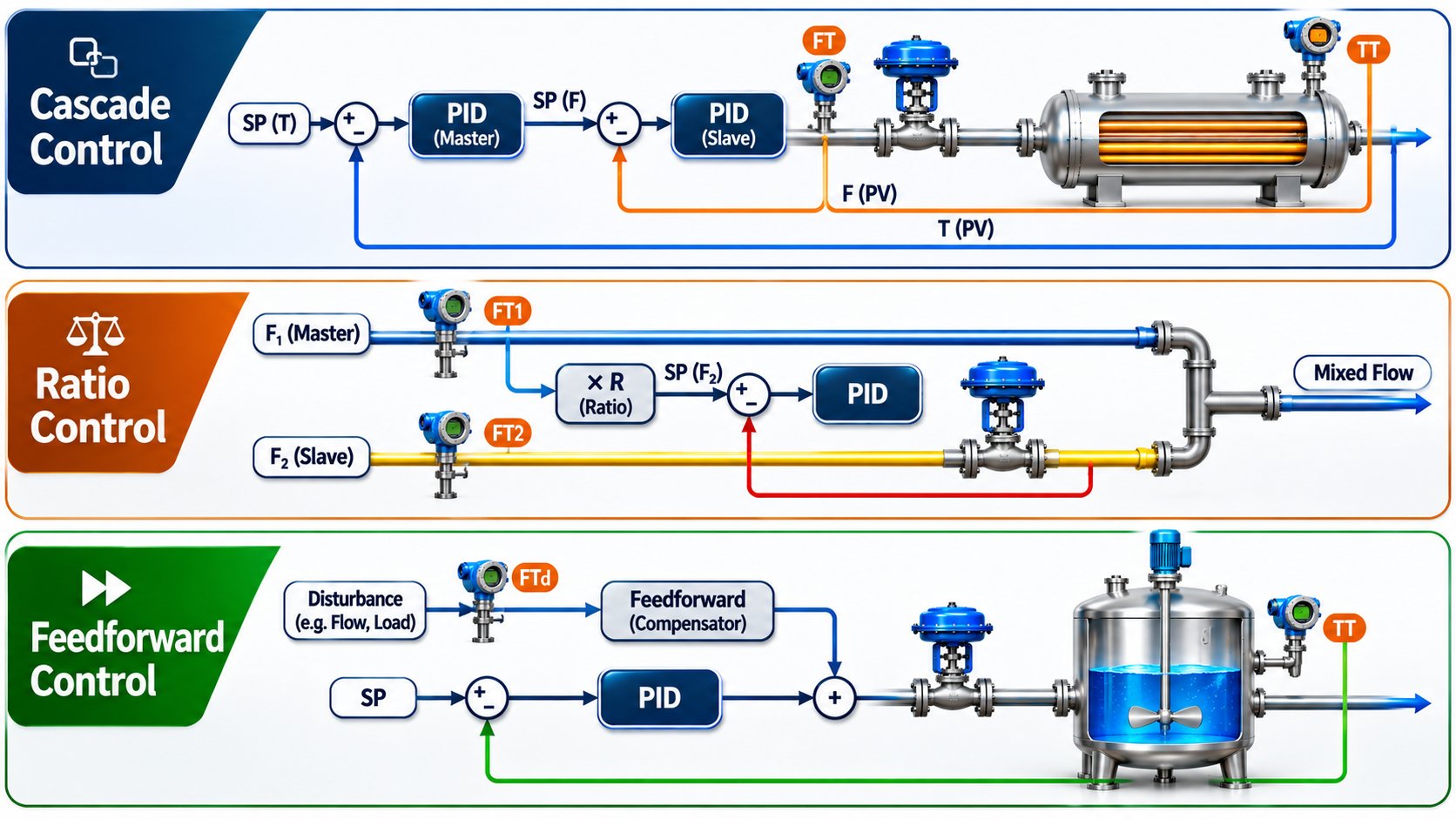
Cascade, ratio and feedforward control strategies shown as block diagrams on a heat exchanger, a blending line and a stirred tank
Course data sheet
Code
PC-03
Track
Process Control, weeks 11–13
Level
Core
Prerequisite
PID Loop Tuning, or equivalent experience
Starts
On demand · begin the week you enrol
Live classes
Tue and Thu 19:00–21:00 WAT, 6 sessions
Clinic
Sat 10:00–12:00, 3 sessions
Assessment
1 graded practical, 2 quizzes
You need
A laptop, Chrome, about six hours a week
Why control strategies

Half the loops that "will not tune" are the wrong structure. The engineer who sees that saves the plant months.

Operators and engineers spend weeks retuning a heater outlet loop that swings every time the fuel pressure changes, when a cascade or a feedforward would have fixed it in an afternoon. Knowing which structure to use, and being able to build and tune it, is what separates a control engineer from someone who adjusts PID settings.

This course is three weeks of designing and tuning real strategies on real process models. You cascade a heater, ratio a blend, feedforward a column feed upset, and tune each in the MAT Lab while disturbances hit it. A process control engineer grades your design, your tuning and your control narrative.

Hands-on
9 hours in the lab over three weeks
Graded by
A process control engineer, 8+ years on plants
You keep
A tuned cascade strategy and narrative on your portfolio
Counts toward
The Process Control track and ISA CAP prep
Syllabus

Six sessions, three weeks

  • 12-min pre-class video
  • Live class
  • Quiz
S1When one loop is not enough

Disturbances, nonlinearity and dead time; the signs on the trend that say "change the structure".

S2Cascade control

Inner and outer loops, which variable goes where, tuning order, windup and mode handling.

S3Ratio control

Wild and controlled streams, ratio stations, blending and air-fuel; what happens when the wild flow stops.

S4Feedforward

Static and dynamic feedforward, lead-lag, combining with feedback; when it makes things worse.

S5Strategies in combination

Cascade plus feedforward on a heater; override and selector control introduced.

S6Strategy clinic and practical review Practical due

Your heater strategy defended against injected upsets; practical submission due.

H-201 · OUTLET TEMP · CASCADEFUEL UPSET REJECTED
Outer loop
TIC-201
Inner loop
FIC-202
Peak deviation
1.8 °C
Graded practical

Cascade on a heater outlet temperature.

In the MAT Lab you take a fired heater whose outlet temperature swings with fuel pressure, design and build a cascade with a flow inner loop, tune both loops in the right order, add feedforward from the feed rate, and prove it against injected upsets. Your instructor grades the design, the tuning and your control narrative; it goes on your portfolio.

How the practical runs

From a swinging heater to a rejected upset, in five steps

You are given a heater that will not hold temperature, trends from a week of operation and a rubric. Then you do what the plant would call a consultant for.

  1. 1

    Diagnose

    Read the trends and show why a single loop cannot hold the outlet temperature.

  2. 2

    Design

    Choose the inner variable, draw the strategy, write the narrative.

  3. 3

    Tune inner, then outer

    Tune the flow loop first, then the temperature loop with the inner loop in cascade.

  4. 4

    Add feedforward

    Measure the feed-rate disturbance, design the compensator, add lead-lag.

  5. 5

    Prove it

    Inject fuel and feed upsets; compare before and after; defended at the Saturday clinic.

Who this course is for

Engineers and technicians who are tired of guessing

Control engineers who have tuned PID loops and hit the limit of what one loop can do. Process engineers who specify control strategies on P&IDs. Anyone preparing for a DCS or APC role.

What you walk away with

Skills you can use on Monday, and proof you have them

The judgement to choose the right structure and the skill to build and tune it. A tuned cascade strategy and narrative on your public portfolio. A certificate of completion with a verification code. Credit toward the full Process Control track, where the next course asks when PID is not enough at all.

Process control engineer at a DCS console with the process overview and live loop trends on screen
Your instructor

A practising control engineer who tunes loops for a living

Lead instructor · Process Control track

8+ years on live plants · currently in industry · grades every practical personally

This course is taught by the Process Control lead for your cohort, a practising engineer who does this work on real plants and grades every practical personally. Faculty rotates by cohort, so you meet your instructor on the orientation call.

Track

Course 3 of 5 in Process Control

Courses in the Process Control track
CodeCourseWeeksPriceLink
PC-01 Process Dynamics Weeks 5–7 ₦150,000 View Process Dynamics
PC-02 PID Loop Tuning Weeks 8–10 ₦150,000 View PID Loop Tuning
PC-03 Cascade, Ratio and Feedforward Weeks 11–13 ₦150,000 This course
PC-04 Introduction to Advanced Control Weeks 14–15 ₦150,000 View Introduction to Advanced Control
PC-05 Control Strategy Design from P&IDs Weeks 16–18 ₦150,000 View Control Strategy Design from P&IDs

Take all five and you've completed the track. Already done three? Upgrade to the full track (₦700,000) for the difference.

See the full track
FAQ

Questions

Do I need PID Loop Tuning first?

You need to be able to tune a single loop. PID Loop Tuning or equivalent plant experience is the prerequisite; the admissions call settles borderline cases.

Can I do this course if I am not in Nigeria?

Yes. Classes are 19:00–21:00 West Africa Time; recordings are up within the hour, and you pay in dollars by card.

Does this count toward the track?

Yes. It is course 3 of 5 in Process Control. Finish three courses and you can upgrade to the full track for the difference.

What do I get at the end?

A certificate of completion with a verification code, and your graded practical on your public portfolio.

Cascade, Ratio and Feedforward · on demand

₦150,000 · three weeks · one graded practical

Enrol

Cohort 1 starts 15 January 2027

75 places across three tracks. Applications close when the cohort fills.