

• IN-01
  • Instrumentation · course 1 of 5
  • Graded practical

Measurement Principles

Three weeks on how pressure, flow, level and temperature are really measured, where each technology fails, and how to choose.

weeks
3
live classes
6
graded practical
1
start any time
On demand
Outcomes

What you'll learn

  • Explain how each common pressure, flow, level and temperature technology works
  • Choose a technology for a service and say why the others were rejected
  • Spot the installation effects that make a good instrument read wrong
  • Read a datasheet and a vendor catalogue critically
  • Specify range, accuracy and process connection correctly
  • Write an instrument specification a buyer can order from
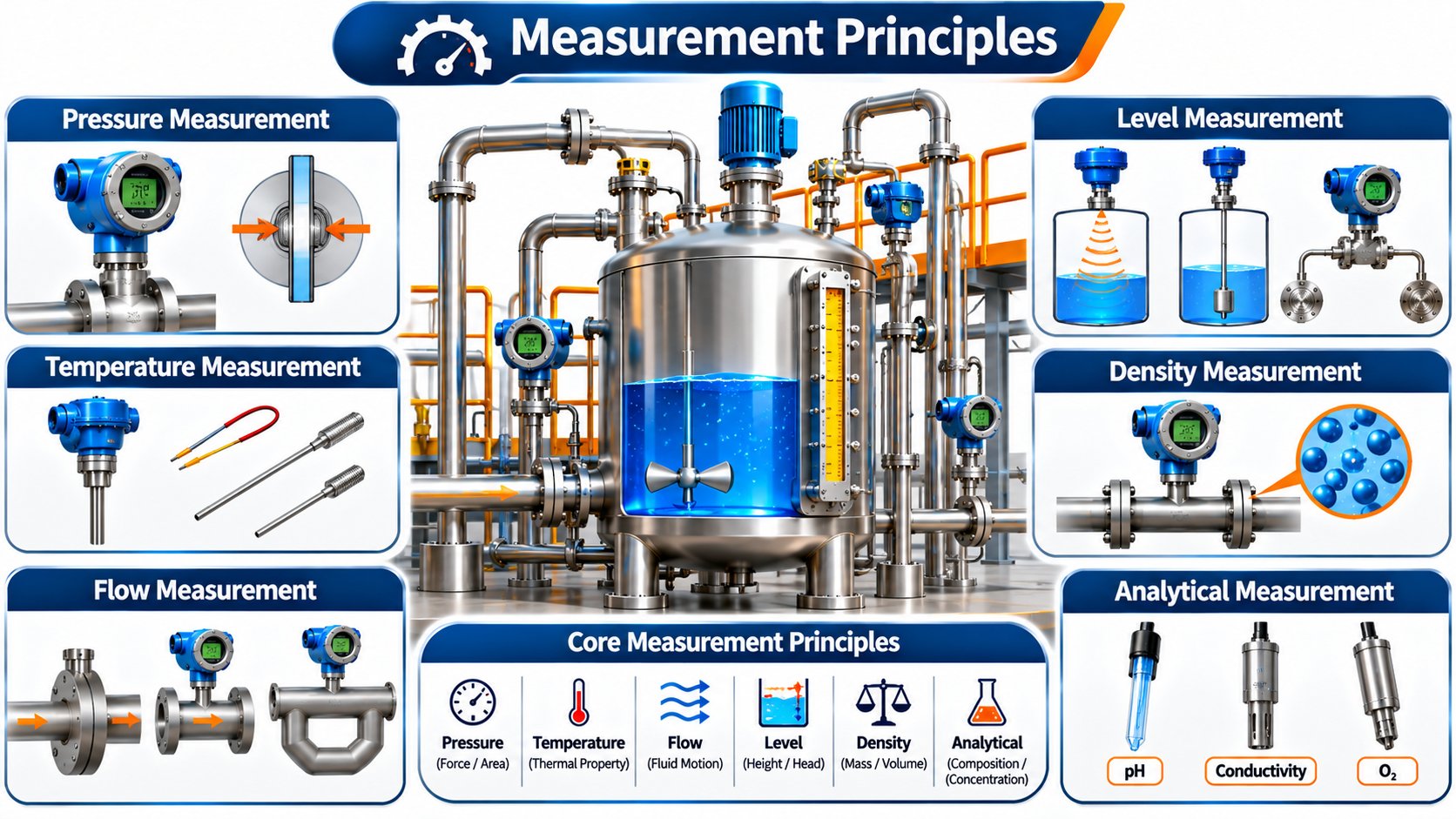
Measurement principles: pressure, temperature, flow, level, density and analytical instruments around a stirred process tank
Course data sheet
Code
IN-01
Track
Instrumentation, weeks 5–7
Level
Core
Prerequisite
Foundation, or a first degree or diploma in a technical subject
Starts
On demand · begin the week you enrol
Live classes
Tue and Thu 19:00–21:00 WAT, 6 sessions
Clinic
Sat 10:00–12:00, 3 sessions
Assessment
1 graded practical, 2 quizzes
You need
A laptop, Chrome, about six hours a week
Why measurement principles

Every control loop and every safety trip trusts a measurement. Most of them were chosen from a catalogue by price.

Plants are full of orifice plates in the wrong place, level transmitters that cannot see foam and thermowells that read the pipe wall. Nobody notices until a trip fails or an invoice is disputed. The instrument engineer who understands the physics behind each technology chooses right the first time and is the person the plant trusts when a reading looks wrong.

This course is three weeks on the physics, the failure modes and the choice. You see each technology respond in the MAT Lab, including what happens when the installation is wrong, and specify every instrument on a three-phase separator with a justification for each. An instrument engineer grades your specification.

Hands-on
9 hours in the lab over three weeks
Graded by
An instrument engineer, 8+ years on plants
You keep
A justified instrument specification on your portfolio
Counts toward
The Instrumentation track and ISA CCST prep
Syllabus

Six sessions, three weeks

  • 12-min pre-class video
  • Live class
  • Quiz
S1Pressure

Gauge, absolute and differential; sensors and their limits; impulse lines, seals and where readings go wrong.

S2Flow

Orifice and DP, magnetic, Coriolis, vortex, ultrasonic; straight runs, Reynolds number, two-phase; choosing by service.

S3Level

DP and wet legs, radar, guided wave, ultrasonic, capacitance, nuclear; foam, interface, density change.

S4Temperature

RTDs and thermocouples, thermowells, response time, self-heating, wiring errors.

S5Choosing and specifying

Range, accuracy, turndown, materials, process connections; reading a datasheet critically.

S6Specification clinic and practical review Practical due

Your separator specification challenged service by service; practical submission due.

V-101 · INSTRUMENT SELECTION12 SERVICES · 12 SPECIFIED
Technologies
9
Rejected options
23
Datasheets
12 / 12
Graded practical

Specify instruments for a separator.

In the MAT Lab you take a three-phase separator P&ID and, for each of its twelve measurement services, choose a technology, reject the alternatives with reasons, and complete the specification: range, accuracy, materials, connection. Your instructor grades the choices and the datasheets; it goes on your portfolio.

How the practical runs

From a P&ID to a justified specification, in five steps

You are given a separator, its process conditions and a rubric. Then you do what an instrument engineer does on every project.

  1. 1

    List the services

    Every measurement the P&ID needs, with its process conditions.

  2. 2

    Shortlist technologies

    Two or three candidates per service from the physics.

  3. 3

    Test the installation

    See each candidate respond in the lab, including the wrong installation.

  4. 4

    Choose and justify

    One technology per service, with the rejections written down.

  5. 5

    Specify

    Complete datasheets; defended at the Saturday clinic.

Who this course is for

Engineers and technicians who are tired of guessing

Electronics, electrical and physics graduates who want their first instrument role. Technicians who swap transmitters and want to understand what they are swapping. Process engineers who specify instruments and want to do it properly.

What you walk away with

Skills you can use on Monday, and proof you have them

An understanding of the physics that makes every later instrumentation decision easier. A justified specification on your public portfolio. A certificate of completion with a verification code. Credit toward the full Instrumentation track, where the next course calibrates what you specified.

MAT lead instructor checking a pressure transmitter in the field with a calibrator reading 4.000 mA
Your instructor

A practising instrument engineer who calibrates and commissions for a living

Lead instructor · Instrumentation track

8+ years on live plants · currently in industry · grades every practical personally

This course is taught by the Instrumentation lead for your cohort, a practising engineer who does this work on real plants and grades every practical personally. Faculty rotates by cohort, so you meet your instructor on the orientation call.

Track

Course 1 of 5 in Instrumentation

Courses in the Instrumentation track
CodeCourseWeeksPriceLink
IN-01 Measurement Principles Weeks 5–7 ₦150,000 This course
IN-02 Transmitter Selection and Calibration Weeks 8–10 ₦150,000 View Transmitter Selection and Calibration
IN-03 Control Valves and Final Elements Weeks 11–13 ₦150,000 View Control Valves and Final Elements
IN-04 Loop Documentation to ISA 5.1 Weeks 14–15 ₦150,000 View Loop Documentation to ISA 5.1
IN-05 Hazardous Areas and Installation Weeks 16–18 ₦150,000 View Hazardous Areas and Installation

Take all five and you've completed the track. Already done three? Upgrade to the full track (₦700,000) for the difference.

See the full track
FAQ

Questions

How much physics is there?

Enough to understand each technology, taught from the instrument not the equation. If you did a technical diploma or degree, you are ready.

Can I do this course if I am not in Nigeria?

Yes. Classes are 19:00–21:00 West Africa Time; recordings are up within the hour, and you pay in dollars by card.

Does this count toward the track?

Yes. It is course 1 of 5 in Instrumentation. Finish three courses and you can upgrade to the full track for the difference.

What do I get at the end?

A certificate of completion with a verification code, and your graded practical on your public portfolio.

Measurement Principles · on demand

₦150,000 · three weeks · one graded practical

Enrol

Cohort 1 starts 15 January 2027

75 places across three tracks. Applications close when the cohort fills.