

• IN-02
  • Instrumentation · course 2 of 5
  • Graded practical

Transmitter Selection and Calibration

Three weeks on ranging, configuring and calibrating transmitters to a procedure, with the records to prove it.

weeks
3
live classes
6
graded practical
1
start any time
On demand
Outcomes

What you'll learn

  • Range and configure a transmitter over HART
  • Run a five-point up-and-down calibration to a written procedure
  • Record as-found and as-left results and decide pass or fail
  • Calculate and state uncertainty honestly
  • Set up a DP level transmitter with wet leg and elevation correctly
  • Build a calibration programme and know what interval to use
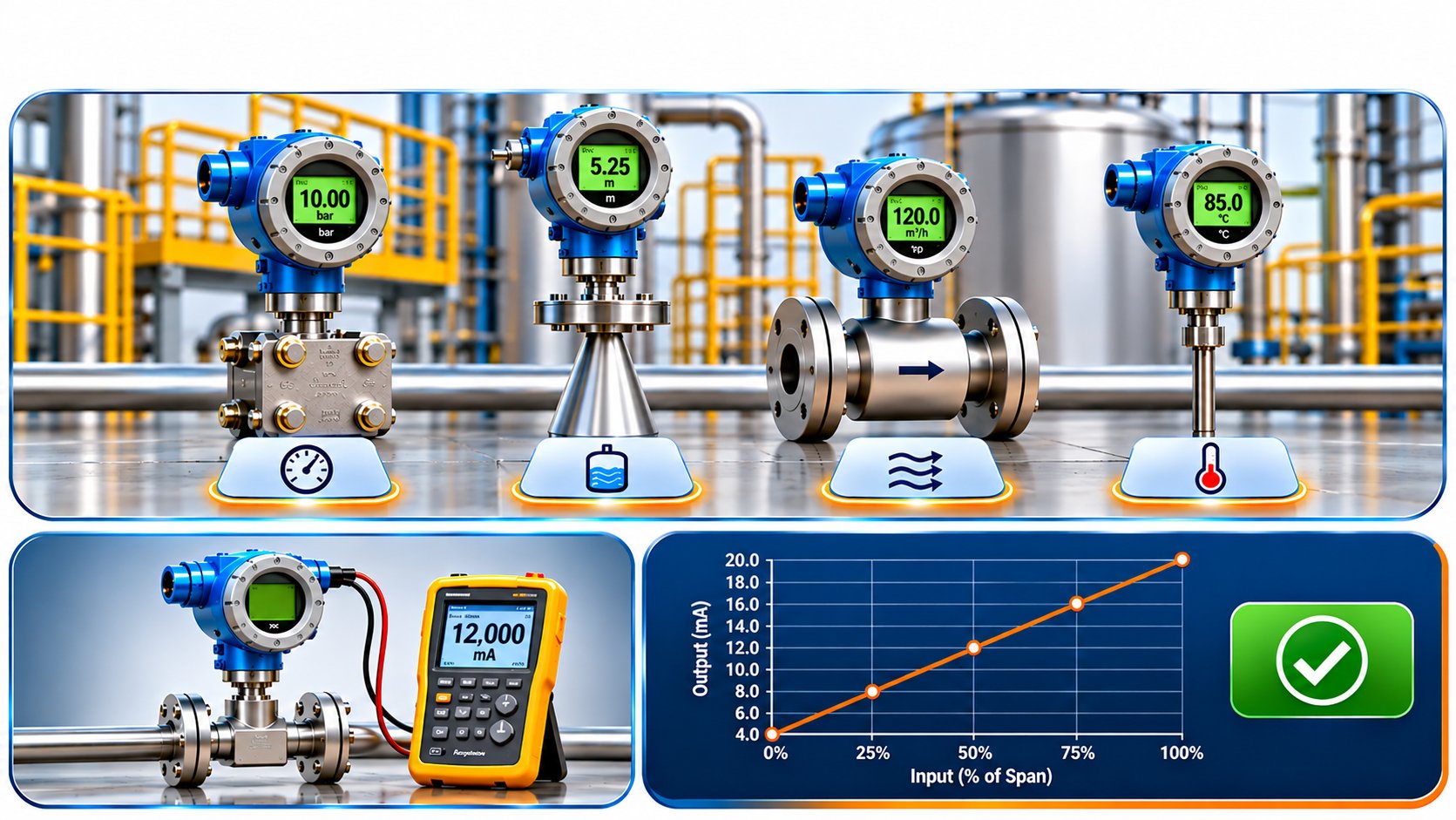
Transmitter selection and calibration: pressure, level, flow and temperature transmitters, a loop calibrator reading 12 mA, and a 4–20 mA calibration curve
Course data sheet
Code
IN-02
Track
Instrumentation, weeks 8–10
Level
Core
Prerequisite
Measurement Principles, or technician experience
Starts
On demand · begin the week you enrol
Live classes
Tue and Thu 19:00–21:00 WAT, 6 sessions
Clinic
Sat 10:00–12:00, 3 sessions
Assessment
1 graded practical, 2 quizzes
You need
A laptop, Chrome, about six hours a week
Why calibration

A transmitter that has not been calibrated is a guess with a display. Plants run on them every day.

Calibration certificates on most sites are years old or were signed without a test. When a trip fails to act or a custody meter is disputed, the first question is "when was it calibrated, and by what procedure?" The technician or engineer who can answer with a record, an uncertainty and a signature is worth more than the instrument.

This course is three weeks of doing it properly. You range and configure transmitters over HART in the MAT Lab, calibrate them against a reference with the drift and hysteresis real instruments have, write the as-found and as-left records and state the uncertainty. An instrument engineer grades your procedure and your certificates.

Hands-on
9 hours in the lab over three weeks
Graded by
An instrument engineer who runs calibration programmes
You keep
Calibration certificates with uncertainty on your portfolio
Counts toward
The Instrumentation track and ISA CCST prep
Syllabus

Six sessions, three weeks

  • 12-min pre-class video
  • Live class
  • Quiz
S1What calibration is and is not

Verification, adjustment, traceability; references and their uncertainty; why "it reads right" is not a calibration.

S2Ranging and HART

LRV, URV, damping, units; HART configuration with a communicator; the mistakes that leave a transmitter reading wrong.

S3The five-point procedure

Up and down, as-found and as-left, tolerances, hysteresis; writing the procedure before touching the instrument.

S4DP level and flow transmitters

Wet legs, elevation and suppression, square-root extraction; where the errors hide.

S5Uncertainty and the programme

Combining reference and instrument uncertainty; calibration intervals; building a programme for a unit.

S6Calibration clinic and practical review Practical due

Your certificates audited line by line; practical submission due.

PT-101 / LT-102 · CALIBRATIONAS LEFT: PASS · ±0.04 % SPAN
Points
5 up / 5 down
As found
−0.31 % · FAIL
Uncertainty
±0.06 %
Graded practical

Calibrate a pressure and a level transmitter.

In the MAT Lab you range and configure a pressure transmitter and a DP level transmitter with a wet leg over HART, calibrate each at five points up and down against a reference, record as-found and as-left, state the uncertainty and sign the certificate. Your instructor grades the procedure, the records and the maths; it goes on your portfolio.

How the practical runs

From a drifted transmitter to a signed certificate, in five steps

You are given two transmitters that have been in service for three years, a reference and a rubric. Then you do what every plant needs done and few do properly.

  1. 1

    Write the procedure

    Points, tolerances, reference, environment; before you touch anything.

  2. 2

    Configure

    LRV, URV, damping and units over HART; wet-leg correction for the level transmitter.

  3. 3

    As found

    Five points up and down against the reference; pass or fail against tolerance.

  4. 4

    Adjust and as left

    Trim, repeat, record; hysteresis checked.

  5. 5

    Certify

    Uncertainty calculated, certificate signed; defended at the Saturday clinic.

Who this course is for

Engineers and technicians who are tired of guessing

Instrument technicians who calibrate but were never taught the procedure or the uncertainty. Graduates who have never held a HART communicator. Engineers who sign calibration records and want to know what they are signing.

What you walk away with

Skills you can use on Monday, and proof you have them

The skill to calibrate any transmitter to a defensible standard. Signed certificates with uncertainty on your public portfolio. A certificate of completion with a verification code. Credit toward the full Instrumentation track, where the next course covers the valve at the other end of the loop.

MAT lead instructor checking a pressure transmitter in the field with a calibrator reading 4.000 mA
Your instructor

A practising instrument engineer who calibrates and commissions for a living

Lead instructor · Instrumentation track

8+ years on live plants · currently in industry · grades every practical personally

This course is taught by the Instrumentation lead for your cohort, a practising engineer who does this work on real plants and grades every practical personally. Faculty rotates by cohort, so you meet your instructor on the orientation call.

Track

Course 2 of 5 in Instrumentation

Courses in the Instrumentation track
CodeCourseWeeksPriceLink
IN-01 Measurement Principles Weeks 5–7 ₦150,000 View Measurement Principles
IN-02 Transmitter Selection and Calibration Weeks 8–10 ₦150,000 This course
IN-03 Control Valves and Final Elements Weeks 11–13 ₦150,000 View Control Valves and Final Elements
IN-04 Loop Documentation to ISA 5.1 Weeks 14–15 ₦150,000 View Loop Documentation to ISA 5.1
IN-05 Hazardous Areas and Installation Weeks 16–18 ₦150,000 View Hazardous Areas and Installation

Take all five and you've completed the track. Already done three? Upgrade to the full track (₦700,000) for the difference.

See the full track
FAQ

Questions

Do I need a real calibrator?

No. The MAT Lab models the transmitters, the reference and the HART communicator in your browser, with the drift and hysteresis real instruments have. Sponsored students can arrange bench time with their employer.

Can I do this course if I am not in Nigeria?

Yes. Classes are 19:00–21:00 West Africa Time; recordings are up within the hour, and you pay in dollars by card.

Does this count toward the track?

Yes. It is course 2 of 5 in Instrumentation. Finish three courses and you can upgrade to the full track for the difference.

What do I get at the end?

A certificate of completion with a verification code, and your graded practical on your public portfolio.

Transmitter Selection and Calibration · on demand

₦150,000 · three weeks · one graded practical

Enrol

Cohort 1 starts 15 January 2027

75 places across three tracks. Applications close when the cohort fills.