

• IA-01
  • Industrial Automation · course 1 of 5
  • Graded practical

PLC Fundamentals

Three weeks from "what is a PLC" to a wired, programmed and tested machine sequence you can show an employer.

weeks
3
live classes
6
graded practical
1
start any time
On demand
Outcomes

What you'll learn

  • Explain the scan cycle and what it means for your logic
  • Wire digital and analogue I/O correctly and read a wiring diagram
  • Choose data types and addresses on a real vendor platform
  • Write, download and test a first program with timers and counters
  • Find a fault from the diagnostics screen, not by guessing
  • Document a program so the next engineer can read it
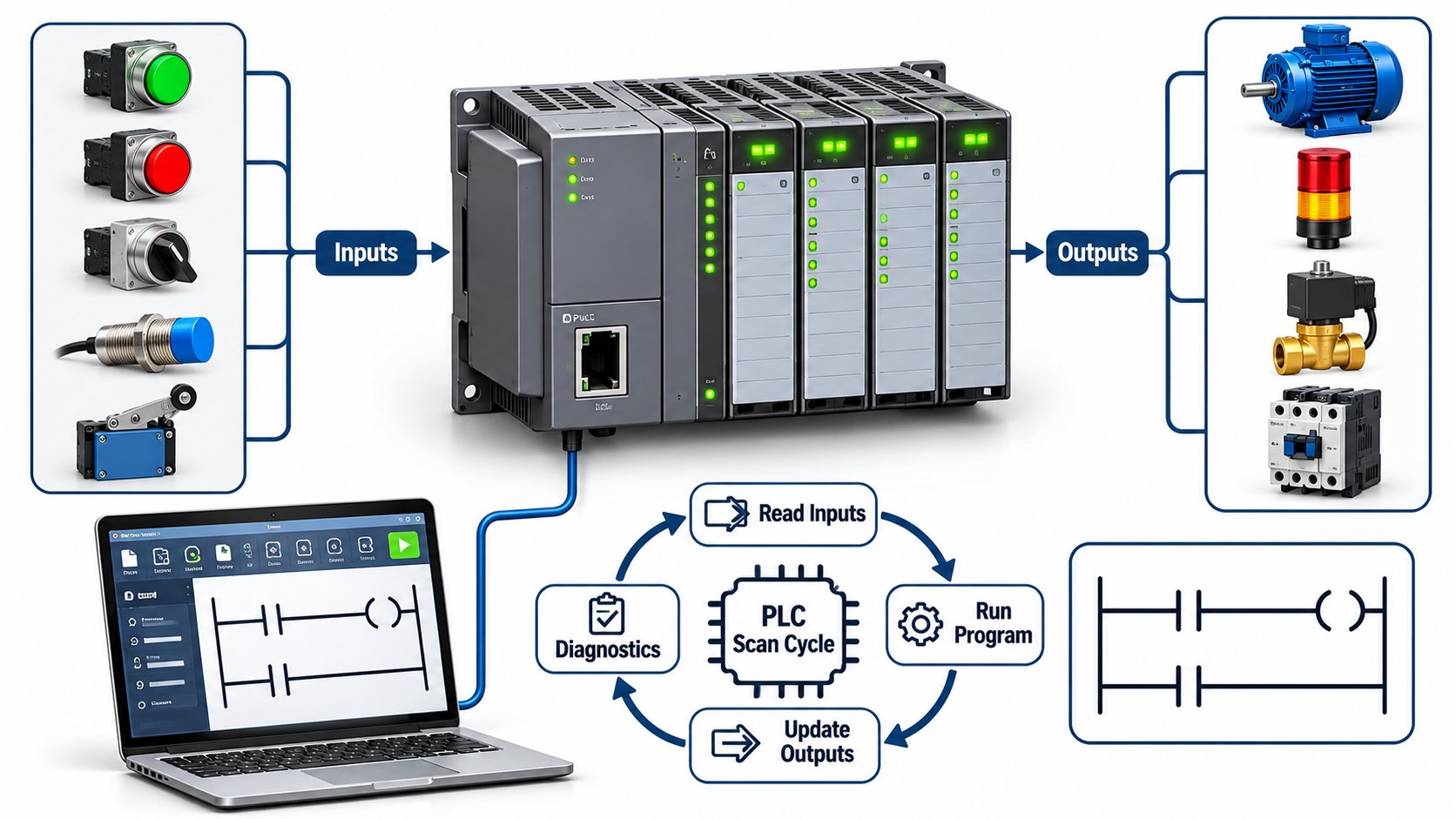
PLC fundamentals: inputs such as push buttons and sensors wired to a PLC rack, outputs to a motor, beacon, valve and contactor, with the scan cycle and a ladder rung
Course data sheet
Code
IA-01
Track
Industrial Automation, weeks 5–7
Level
Core
Prerequisite
Foundation, or basic electrical knowledge
Starts
On demand · begin the week you enrol
Live classes
Tue and Thu 19:00–21:00 WAT, 6 sessions
Clinic
Sat 10:00–12:00, 3 sessions
Assessment
1 graded practical, 2 quizzes
You need
A laptop, Chrome, about six hours a week
Why PLC fundamentals

Every line in every plant stops at a PLC. Most of the people standing in front of it cannot open the program.

Packaging halls, breweries, cement mills and water works all run on PLCs programmed years ago by someone who has left. The engineer who can open the program, understand the scan, trace an input to an output and make a safe change is the one the plant manager phones first. Most graduates have seen a ladder rung in a textbook and never made a motor start.

This course fixes that in three weeks. You wire I/O, write a working program on a real vendor platform, download it to a simulated controller in the MAT Lab and make a tank fill, stop and alarm the way a plant would expect. An automation engineer grades the program and the wiring diagram.

Hands-on
9 hours in the lab over three weeks
Graded by
An automation engineer, 8+ years on live plants
You keep
A tested PLC program and wiring diagram on your portfolio
Counts toward
The Industrial Automation track
Syllabus

Six sessions, three weeks

  • 12-min pre-class video
  • Live class
  • Quiz
S1What a PLC is and how it scans

Inputs, program, outputs, scan time; why the order of rungs matters; where PLCs sit between sensors and the DCS.

S2I/O and wiring

Sinking and sourcing, 24 V DC and 4–20 mA, terminal numbering, reading a wiring diagram and finding your point on it.

S3Addressing and data types

Bits, integers, reals, timers and counters on a real vendor platform; tags versus addresses; naming that survives a handover.

S4Your first program

Start, stop, seal-in, interlock; download, monitor online, force an input, watch it run.

S5Timers, counters and sequences

TON, TOF, counters and a simple state machine for a tank fill.

S6Diagnostics clinic and practical review Practical due

Fault finding from the controller diagnostics; practical submission due.

TK-101 · FILL SEQUENCE · ONLINE MONITORRUNNING · STEP 3 OF 5
Scan time
4.2 ms
Inputs on
7 / 12
Faults
0
Graded practical

Wire and program a tank fill sequence.

In the MAT Lab you wire the I/O for a tank with two level switches, a pump and a valve, write the fill-stop-alarm sequence with timers and a counter, download it and prove it runs. Your instructor grades the program, the wiring diagram and your fault-finding log; it goes on your portfolio.

How the practical runs

From a one-page spec to a running sequence, in five steps

You are given a tank, a sequence description and a rubric that says exactly how it will be graded. Then you do what a plant would pay you to do.

  1. 1

    Read the spec

    A one-page sequence description and a P&ID, the way a contractor would hand it over.

  2. 2

    Wire it

    Assign and wire every I/O point in the lab's virtual cabinet; produce the wiring diagram.

  3. 3

    Program it

    Write the sequence with seal-ins, interlocks, timers and a batch counter.

  4. 4

    Test it

    Download, run, force inputs, inject a stuck level switch and handle it.

  5. 5

    Hand it over

    Commented program, wiring diagram and test log; defended at the Saturday clinic.

Who this course is for

Engineers and technicians who are tired of guessing

Fresh electrical, mechatronics and mechanical graduates who want their first controls role. Electricians and technicians who reset faults every shift without knowing why. Anyone who has been told "learn PLCs" and did not know where to start. If you can read a simple circuit, you are ready.

What you walk away with

Skills you can use on Monday, and proof you have them

The ability to open any PLC program and understand what it is doing. A tested program and wiring diagram on your public portfolio. A certificate of completion with a verification code. Credit toward the full Industrial Automation track, where the next course takes you into structured programming on two platforms.

Automation engineer in a hard hat working at a PLC rack in a field control cabinet, laptop open on the ladder logic
Your instructor

A practising automation engineer who programs PLCs for a living

Lead instructor · Industrial Automation track

8+ years on live plants · currently in industry · grades every practical personally

This course is taught by the Industrial Automation lead for your cohort, a practising engineer who does this work on real plants and grades every practical personally. Faculty rotates by cohort, so you meet your instructor on the orientation call.

Track

Course 1 of 5 in Industrial Automation

Courses in the Industrial Automation track
CodeCourseWeeksPriceLink
IA-01 PLC Fundamentals Weeks 5–7 ₦150,000 This course
IA-02 PLC Programming: Ladder, ST and FBD Weeks 8–10 ₦150,000 View PLC Programming: Ladder, ST and FBD
IA-03 HMI and SCADA Design Weeks 11–13 ₦150,000 View HMI and SCADA Design
IA-04 Industrial Networks Weeks 14–15 ₦150,000 View Industrial Networks
IA-05 Motor Control, VFDs and Commissioning Weeks 16–18 ₦150,000 View Motor Control, VFDs and Commissioning

Take all five and you've completed the track. Already done three? Upgrade to the full track (₦700,000) for the difference.

See the full track
FAQ

Questions

Which PLC brand is used?

One of the two vendor platforms used on the full track, chosen for how common it is on Nigerian plants; it is confirmed at enrolment. The concepts transfer to any brand.

Do I need to buy a PLC?

No. The MAT Lab runs the controller and the machine model in your browser, and we show you how to get the free version of the programming software for your laptop.

Does this count toward the track?

Yes. It is course 1 of 5 in Industrial Automation. Finish three courses and you can upgrade to the full track for the difference.

What do I get at the end?

A certificate of completion with a verification code, and your graded practical on your public portfolio.

PLC Fundamentals · on demand

₦150,000 · three weeks · one graded practical

Enrol

Cohort 1 starts 15 January 2027

75 places across three tracks. Applications close when the cohort fills.