

• IA-02
  • Industrial Automation · course 2 of 5
  • Graded practical

PLC Programming: Ladder, ST and FBD

Three weeks of real programming on two vendor platforms: state machines, fault handling and code another engineer can maintain.

weeks
3
live classes
6
graded practical
1
start any time
On demand
Outcomes

What you'll learn

  • Write the same logic in ladder, ST and FBD and know when to use each
  • Structure a program into routines and function blocks that can be reused
  • Build a state machine for a multi-step sequence
  • Handle faults and recovery without restarting the machine
  • Move between two vendor platforms without relearning everything
  • Comment and version code so a plant can maintain it
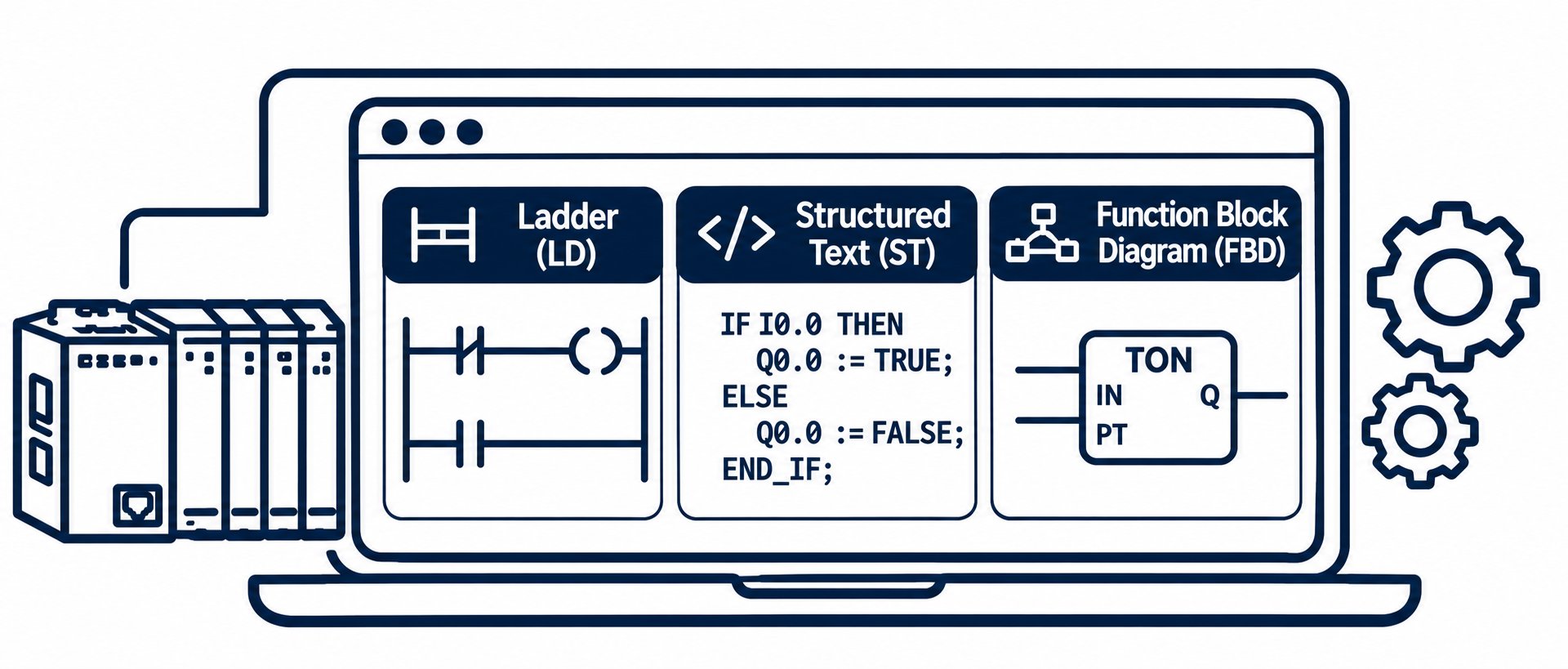
PLC programming in ladder, structured text and function block diagram on a laptop beside a PLC rack
Course data sheet
Code
IA-02
Track
Industrial Automation, weeks 8–10
Level
Core
Prerequisite
PLC Fundamentals, or a working knowledge of one PLC platform
Starts
On demand · begin the week you enrol
Live classes
Tue and Thu 19:00–21:00 WAT, 6 sessions
Clinic
Sat 10:00–12:00, 3 sessions
Assessment
1 graded practical, 2 quizzes
You need
A laptop, Chrome, about six hours a week
Why structured programming

A program that works is not the same as a program a plant can live with for ten years.

Most PLC code on Nigerian lines is a single long ladder that only its author understood. When the line changes, the contractor is called back, or the plant lives with the limitation. Engineers who can write structured, readable logic in the IEC 61131-3 languages, on more than one platform, are rare and are paid accordingly.

This course is three weeks of writing real programs. You build a packaging-line sequence as a state machine, write the same logic in ladder, structured text and function block, handle faults and restarts, and do it on two vendor platforms so you are not tied to one. An automation engineer reviews your code the way a lead would in a design review.

Hands-on
10 hours in the lab over three weeks
Graded by
An automation engineer, 8+ years on live plants
You keep
A reviewed packaging-line program in two languages
Counts toward
The Industrial Automation track
Syllabus

Six sessions, three weeks

  • 12-min pre-class video
  • Live class
  • Quiz
S1IEC 61131-3: the five languages and why three matter

Ladder, structured text and function block diagram; what each is good at; how the same rung looks in all three.

S2Program structure

Tasks, routines, function blocks and user-defined types; naming, scope and reuse.

S3State machines

Designing a sequence as states and transitions; implementing it in ST and in ladder; why it beats a chain of seal-ins.

S4Fault handling and recovery

Detecting a jam, holding the state, operator reset, restarting from where you stopped.

S5The second platform

The same sequence on the other vendor: what changes, what does not, how to read unfamiliar code.

S6Code review clinic and practical review Practical due

Your program reviewed live against the rubric; practical submission due.

LINE 3 · SEQUENCE · STATE MACHINESTEP: CAPPING · FAULT RESET OK
States
9
Fault recoveries
3 / 3
Platforms
2
Graded practical

Program a packaging line sequence with fault recovery.

In the MAT Lab you take a packaging line with infeed, filler, capper and packer and write the full start-up, run, jam and restart sequence as a state machine, in structured text and ladder, on two vendor platforms. Your instructor reviews the code against the rubric; it goes on your portfolio.

How the practical runs

From a machine description to maintainable code, in five steps

You are given a packaging line, an operating description and a rubric. Then you write the program a plant would want to keep.

  1. 1

    Design the states

    Draw the state diagram from the machine description before writing a line of code.

  2. 2

    Write it in ST

    Implement the state machine in structured text with timers and interlocks.

  3. 3

    Write it in ladder

    The same logic in ladder on the same platform; compare readability and maintainability.

  4. 4

    Break it

    Inject a capper jam and a sensor failure; recover without a cold restart.

  5. 5

    Port and review

    Port it to the second platform; present both at the Saturday code review.

Who this course is for

Engineers and technicians who are tired of guessing

Engineers who have made a motor start and want to write real programs. Technicians who maintain lines and want to change the logic safely. Anyone preparing for an automation or controls engineer interview where you will be asked to write code on a whiteboard.

What you walk away with

Skills you can use on Monday, and proof you have them

Fluency in the three languages that matter and the confidence to open code on an unfamiliar platform. A reviewed packaging-line program on your public portfolio. A certificate of completion with a verification code. Credit toward the full Industrial Automation track, where the next course puts a screen in front of your program.

Automation engineer in a hard hat working at a PLC rack in a field control cabinet, laptop open on the ladder logic
Your instructor

A practising automation engineer who programs PLCs for a living

Lead instructor · Industrial Automation track

8+ years on live plants · currently in industry · grades every practical personally

This course is taught by the Industrial Automation lead for your cohort, a practising engineer who does this work on real plants and grades every practical personally. Faculty rotates by cohort, so you meet your instructor on the orientation call.

Track

Course 2 of 5 in Industrial Automation

Courses in the Industrial Automation track
CodeCourseWeeksPriceLink
IA-01 PLC Fundamentals Weeks 5–7 ₦150,000 View PLC Fundamentals
IA-02 PLC Programming: Ladder, ST and FBD Weeks 8–10 ₦150,000 This course
IA-03 HMI and SCADA Design Weeks 11–13 ₦150,000 View HMI and SCADA Design
IA-04 Industrial Networks Weeks 14–15 ₦150,000 View Industrial Networks
IA-05 Motor Control, VFDs and Commissioning Weeks 16–18 ₦150,000 View Motor Control, VFDs and Commissioning

Take all five and you've completed the track. Already done three? Upgrade to the full track (₦700,000) for the difference.

See the full track
FAQ

Questions

Which two platforms?

The two most common on Nigerian plants, confirmed at enrolment. You learn the languages, so the skills carry to any vendor.

I have only used ladder. Will I cope with ST?

Yes. Session 1 shows the same rung in all three languages and the course builds up from there. Most students prefer ST for sequences by week two.

Does this count toward the track?

Yes. It is course 2 of 5 in Industrial Automation. Finish three courses and you can upgrade to the full track for the difference.

What do I get at the end?

A certificate of completion with a verification code, and your graded practical on your public portfolio.

PLC Programming: Ladder, ST and FBD · on demand

₦150,000 · three weeks · one graded practical

Enrol

Cohort 1 starts 15 January 2027

75 places across three tracks. Applications close when the cohort fills.